Don't Overlook It! The "Energy Code" for Livestock and Poultry Growth: A Complete Guide to How SUBU21 Supplements Vitamin B1 for Farmed Animals
author: Jing Wu
2025-10-04
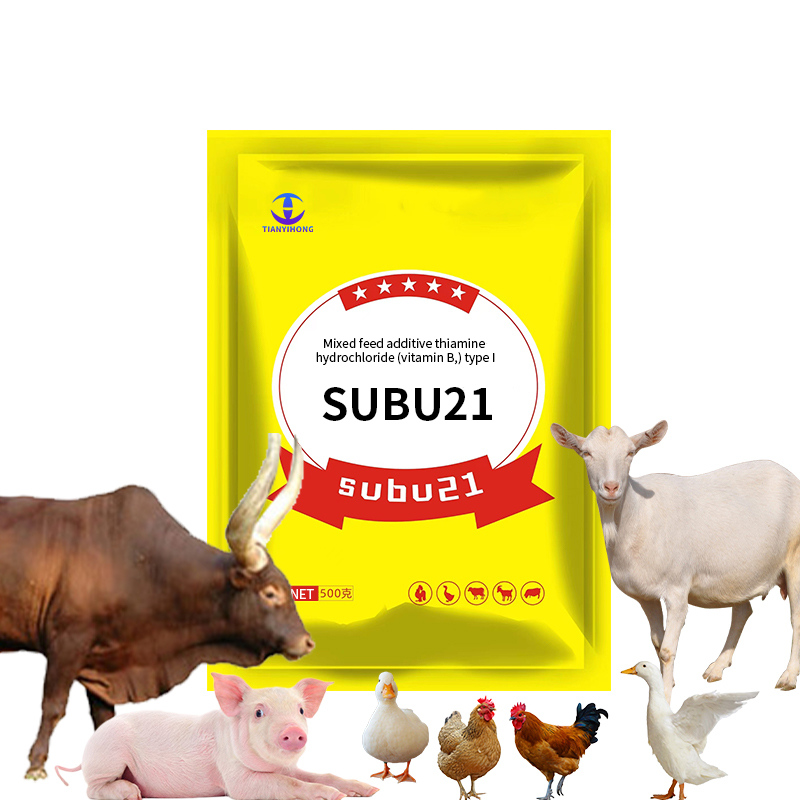
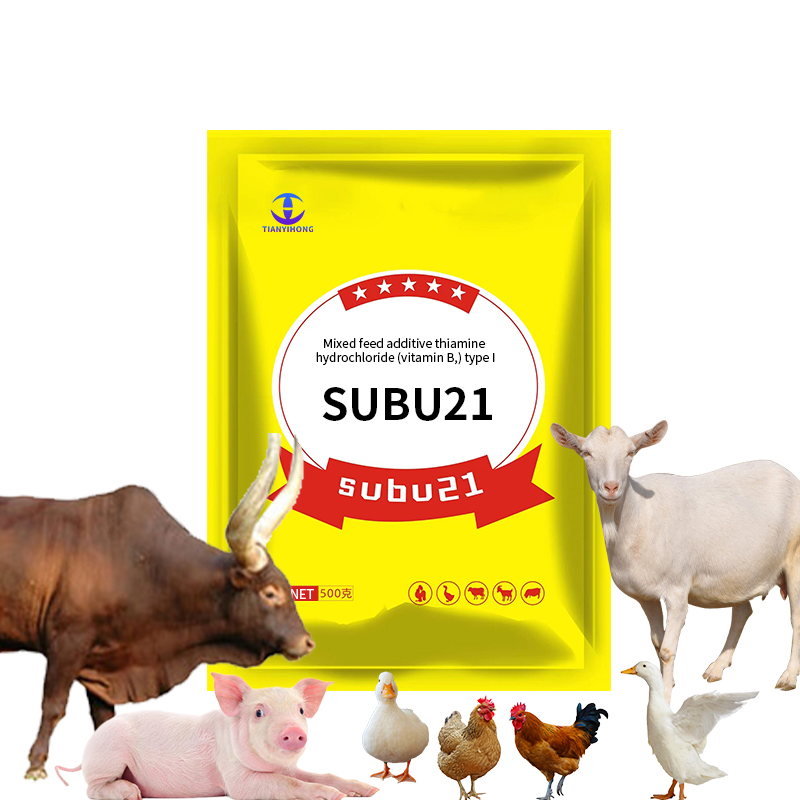
In the process of livestock and poultry farming, farmers often focus on the protein and energy content of feed, but easily overlook a "energy code" crucial to animal growth—vitamin B1. This seemingly insignificant nutrient, if deficient, can cause considerable losses in farming. As a vitamin B1 supplement developed specifically for farmed animals, SUBU21 has become a key support for safeguarding the health of livestock and poultry. Today, we will delve into the importance of vitamin B1 and how SUBU21 scientifically supplements this essential nutrient for livestock and poultry.
I. Vitamin B1: The Indispensable "Energy Converter" for Livestock and Poultry Growth
Vitamin B1, also known as thiamine, is a vital member of the B-vitamin family and plays a key role as an "energy converter" in livestock and poultry. The carbohydrates that livestock and poultry consume daily can only be converted into energy required for growth and activities with the participation of vitamin B1. Whether it is the rapid weight gain of broilers, the continuous egg production of layers, or the fattening of pigs, none can do without the efficient energy conversion function of vitamin B1.
Meanwhile, vitamin B1 is also crucial to the neurological health of livestock and poultry. It maintains the normal physiological functions of nerve tissue and ensures the smooth transmission of nerve signals. If livestock and poultry lack vitamin B1, their nervous system functions will be disrupted, which in turn affects their normal feeding, movement, and stress response capabilities. For example, layers may experience decreased egg production rate and poor eggshell quality; broilers may suffer from stunted growth and reduced feed conversion rate; pigs may show symptoms such as listlessness and unsteady standing.
More seriously, long-term vitamin B1 deficiency can lead to typical deficiency diseases in livestock and poultry. Take chicks as an example, they may develop "polyneuritis," characterized by symptoms such as head tilting back, circling, and convulsions, which can lead to direct death in severe cases; adult chickens, on the other hand, may have problems like fluffy feathers and weight loss. For pigs, vitamin B1 deficiency may cause "beriberi" , resulting in muscle atrophy, movement disorders, and even affecting reproductive performance. These symptoms not only reduce farming efficiency but also increase the mortality rate of livestock and poultry, bringing huge economic losses to farmers.
II. SUBU21: Targeted Solution to Vitamin B1 Deficiency in Livestock and Poultry
Facing the risk of vitamin B1 deficiency in livestock and poultry, SUBU21 has become a capable assistant for farmers with its scientific formula and high-quality ingredients. In terms of composition, SUBU21 takes thiamine hydrochloride (vitamin B1) as the core active ingredient, paired with anhydrous glucose as a carrier. Thiamine hydrochloride is a stable form of vitamin B1, ensuring effective absorption and utilization by livestock and poultry after ingestion; anhydrous glucose not only serves as an energy source to provide additional energy for livestock and poultry but also improves the solubility and stability of thiamine hydrochloride in feed or drinking water, ensuring the uniform dispersion of nutrients and avoiding the problem of local excessive or insufficient concentration.
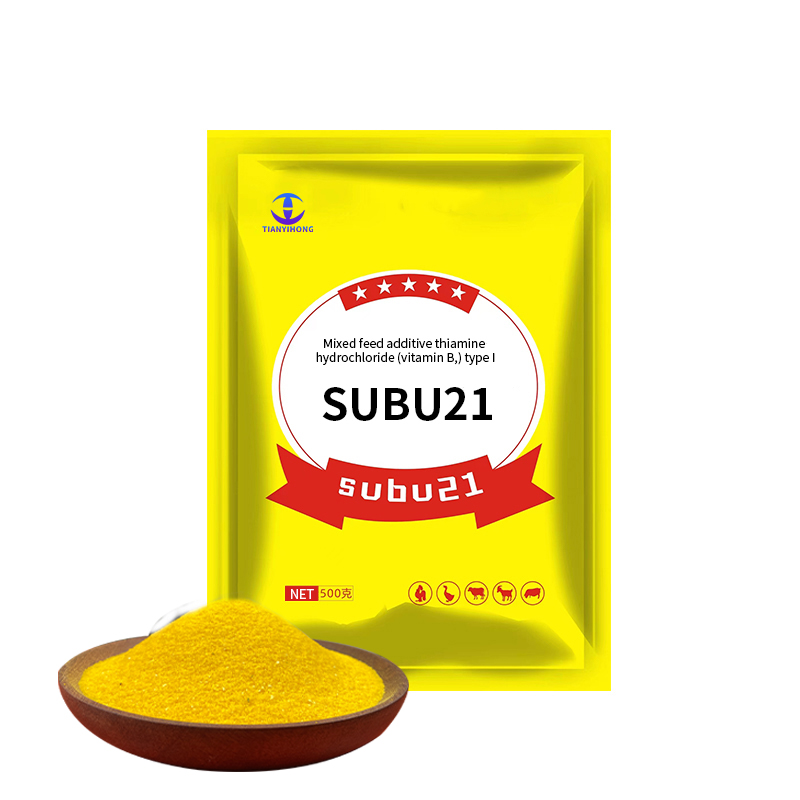
In terms of physical properties, SUBU21 exhibits significant advantages. It appears as a uniform powder with consistent color, free from any deterioration, caking, or unusual odor. This stable physical state, on one hand, facilitates farmers to fully mix it with feed or drinking water, ensuring that each animal intakes a sufficient amount of vitamin B1; on the other hand, its good stability can prevent nutrient loss or potential risks to livestock and poultry health caused by product deterioration and caking. Even in different breeding environments, such as southern regions with high air humidity, SUBU21 can maintain a good state and continuously provide stable vitamin B1 supplementation for livestock and poultry.
III. Scientific Use of SUBU21: Master the Methods for Optimal Results
To allow SUBU21 to fully exert its effect of supplementing vitamin B1, scientific usage methods are crucial. First is the control of the reference dosage. According to the product instructions, 500 grams of SUBU21 can be mixed with 2500 kilograms of feed or dissolved in 5000 kilograms of drinking water. This dosage is verified through a large number of experiments and can meet the basic vitamin B1 needs of livestock and poultry of different breeds and growth stages. However, in actual use, farmers need to make flexible adjustments based on specific conditions. For example, when the moisture content of the feed is high, the addition amount of SUBU21 can be appropriately increased to prevent moisture from affecting the absorption of nutrients; in high-temperature and high-humidity seasons, the demand for vitamin B1 by livestock and poultry may increase, so the dosage also needs to be adjusted accordingly to ensure sufficient nutrient intake.
Second, mixing uniformity is key. When in use, SUBU21 must be fully and evenly mixed with feed to avoid local excessive or insufficient concentration. If the mixing is uneven, some livestock and poultry may face increased physical burden due to excessive vitamin B1 intake, while others may fail to obtain sufficient nutrients and still face the risk of deficiency. For the drinking water addition method, it is necessary to ensure that SUBU21 is completely dissolved in water without precipitation, so that every sip of drinking water contains uniform vitamin B1 components.
In addition, the storage of leftover products and overall storage conditions cannot be ignored. Any leftover SUBU21 should be sealed immediately to prevent moisture-induced failure. During the entire storage process, the product should be placed in a well-ventilated and dry warehouse, away from moisture and direct sunlight. The shelf life of SUBU21 is 24 months, so farmers should check the production date and use the product within the shelf life to avoid affecting the supplementation effect or even endangering the health of livestock and poultry due to the use of expired products.
IV. SUBU21: Safeguarding Livestock and Poultry Farming and Enhancing Breeding Benefits
Under the current large-scale and intensive breeding model, livestock and poultry face higher requirements for growth performance and more complex environmental pressures, resulting in a more urgent demand for vitamin B1. The emergence of SUBU21 provides farmers with a simple, efficient, and safe vitamin B1 supplementation solution. Through the scientific use of SUBU21, the occurrence of vitamin B1 deficiency in livestock and poultry can be effectively prevented, and the normal growth, development, and physiological functions of livestock and poultry can be guaranteed.
For broiler farming, supplementing vitamin B1 can improve energy conversion efficiency, promote rapid weight gain of broilers, shorten the breeding cycle, while reducing the incidence of diseases and increasing the survival rate; in layer farming, sufficient vitamin B1 can maintain the egg production rate of layers, improve eggshell quality, reduce the broken egg rate, and enhance the commercial value of eggs; for pig farming, supplementing vitamin B1 helps improve the feeding enthusiasm of pigs, promote growth, improve meat quality, and at the same time enhance the stress resistance of pigs, reducing growth retardation caused by factors such as environmental changes.
In summary, as a product dedicated to supplementing vitamin B1 for farmed animals, SUBU21 not only solves the problem of vitamin B1 deficiency in livestock and poultry but also provides strong support for farmers to improve breeding benefits and achieve sustainable farming. Mastering the importance of vitamin B1 and the scientific usage methods of SUBU21 will build a solid "energy defense line" for the healthy growth of livestock and poultry, making the farming journey smoother.
I. Vitamin B1: The Indispensable "Energy Converter" for Livestock and Poultry Growth
Vitamin B1, also known as thiamine, is a vital member of the B-vitamin family and plays a key role as an "energy converter" in livestock and poultry. The carbohydrates that livestock and poultry consume daily can only be converted into energy required for growth and activities with the participation of vitamin B1. Whether it is the rapid weight gain of broilers, the continuous egg production of layers, or the fattening of pigs, none can do without the efficient energy conversion function of vitamin B1.
Meanwhile, vitamin B1 is also crucial to the neurological health of livestock and poultry. It maintains the normal physiological functions of nerve tissue and ensures the smooth transmission of nerve signals. If livestock and poultry lack vitamin B1, their nervous system functions will be disrupted, which in turn affects their normal feeding, movement, and stress response capabilities. For example, layers may experience decreased egg production rate and poor eggshell quality; broilers may suffer from stunted growth and reduced feed conversion rate; pigs may show symptoms such as listlessness and unsteady standing.
More seriously, long-term vitamin B1 deficiency can lead to typical deficiency diseases in livestock and poultry. Take chicks as an example, they may develop "polyneuritis," characterized by symptoms such as head tilting back, circling, and convulsions, which can lead to direct death in severe cases; adult chickens, on the other hand, may have problems like fluffy feathers and weight loss. For pigs, vitamin B1 deficiency may cause "beriberi" , resulting in muscle atrophy, movement disorders, and even affecting reproductive performance. These symptoms not only reduce farming efficiency but also increase the mortality rate of livestock and poultry, bringing huge economic losses to farmers.
II. SUBU21: Targeted Solution to Vitamin B1 Deficiency in Livestock and Poultry
Facing the risk of vitamin B1 deficiency in livestock and poultry, SUBU21 has become a capable assistant for farmers with its scientific formula and high-quality ingredients. In terms of composition, SUBU21 takes thiamine hydrochloride (vitamin B1) as the core active ingredient, paired with anhydrous glucose as a carrier. Thiamine hydrochloride is a stable form of vitamin B1, ensuring effective absorption and utilization by livestock and poultry after ingestion; anhydrous glucose not only serves as an energy source to provide additional energy for livestock and poultry but also improves the solubility and stability of thiamine hydrochloride in feed or drinking water, ensuring the uniform dispersion of nutrients and avoiding the problem of local excessive or insufficient concentration.
In terms of physical properties, SUBU21 exhibits significant advantages. It appears as a uniform powder with consistent color, free from any deterioration, caking, or unusual odor. This stable physical state, on one hand, facilitates farmers to fully mix it with feed or drinking water, ensuring that each animal intakes a sufficient amount of vitamin B1; on the other hand, its good stability can prevent nutrient loss or potential risks to livestock and poultry health caused by product deterioration and caking. Even in different breeding environments, such as southern regions with high air humidity, SUBU21 can maintain a good state and continuously provide stable vitamin B1 supplementation for livestock and poultry.
III. Scientific Use of SUBU21: Master the Methods for Optimal Results
To allow SUBU21 to fully exert its effect of supplementing vitamin B1, scientific usage methods are crucial. First is the control of the reference dosage. According to the product instructions, 500 grams of SUBU21 can be mixed with 2500 kilograms of feed or dissolved in 5000 kilograms of drinking water. This dosage is verified through a large number of experiments and can meet the basic vitamin B1 needs of livestock and poultry of different breeds and growth stages. However, in actual use, farmers need to make flexible adjustments based on specific conditions. For example, when the moisture content of the feed is high, the addition amount of SUBU21 can be appropriately increased to prevent moisture from affecting the absorption of nutrients; in high-temperature and high-humidity seasons, the demand for vitamin B1 by livestock and poultry may increase, so the dosage also needs to be adjusted accordingly to ensure sufficient nutrient intake.
Second, mixing uniformity is key. When in use, SUBU21 must be fully and evenly mixed with feed to avoid local excessive or insufficient concentration. If the mixing is uneven, some livestock and poultry may face increased physical burden due to excessive vitamin B1 intake, while others may fail to obtain sufficient nutrients and still face the risk of deficiency. For the drinking water addition method, it is necessary to ensure that SUBU21 is completely dissolved in water without precipitation, so that every sip of drinking water contains uniform vitamin B1 components.
In addition, the storage of leftover products and overall storage conditions cannot be ignored. Any leftover SUBU21 should be sealed immediately to prevent moisture-induced failure. During the entire storage process, the product should be placed in a well-ventilated and dry warehouse, away from moisture and direct sunlight. The shelf life of SUBU21 is 24 months, so farmers should check the production date and use the product within the shelf life to avoid affecting the supplementation effect or even endangering the health of livestock and poultry due to the use of expired products.
IV. SUBU21: Safeguarding Livestock and Poultry Farming and Enhancing Breeding Benefits
Under the current large-scale and intensive breeding model, livestock and poultry face higher requirements for growth performance and more complex environmental pressures, resulting in a more urgent demand for vitamin B1. The emergence of SUBU21 provides farmers with a simple, efficient, and safe vitamin B1 supplementation solution. Through the scientific use of SUBU21, the occurrence of vitamin B1 deficiency in livestock and poultry can be effectively prevented, and the normal growth, development, and physiological functions of livestock and poultry can be guaranteed.
For broiler farming, supplementing vitamin B1 can improve energy conversion efficiency, promote rapid weight gain of broilers, shorten the breeding cycle, while reducing the incidence of diseases and increasing the survival rate; in layer farming, sufficient vitamin B1 can maintain the egg production rate of layers, improve eggshell quality, reduce the broken egg rate, and enhance the commercial value of eggs; for pig farming, supplementing vitamin B1 helps improve the feeding enthusiasm of pigs, promote growth, improve meat quality, and at the same time enhance the stress resistance of pigs, reducing growth retardation caused by factors such as environmental changes.
In summary, as a product dedicated to supplementing vitamin B1 for farmed animals, SUBU21 not only solves the problem of vitamin B1 deficiency in livestock and poultry but also provides strong support for farmers to improve breeding benefits and achieve sustainable farming. Mastering the importance of vitamin B1 and the scientific usage methods of SUBU21 will build a solid "energy defense line" for the healthy growth of livestock and poultry, making the farming journey smoother.
Aquaculture Growth Booster: Skyrocket Your Farming Profits!
Zhengzhou Yufangtang (Biology) Supply Chain Management Co., Ltd. Shines at the Inaugural 2025 Zhengzhou International Cross-Border E-Commerce Trade Fair
Related Article
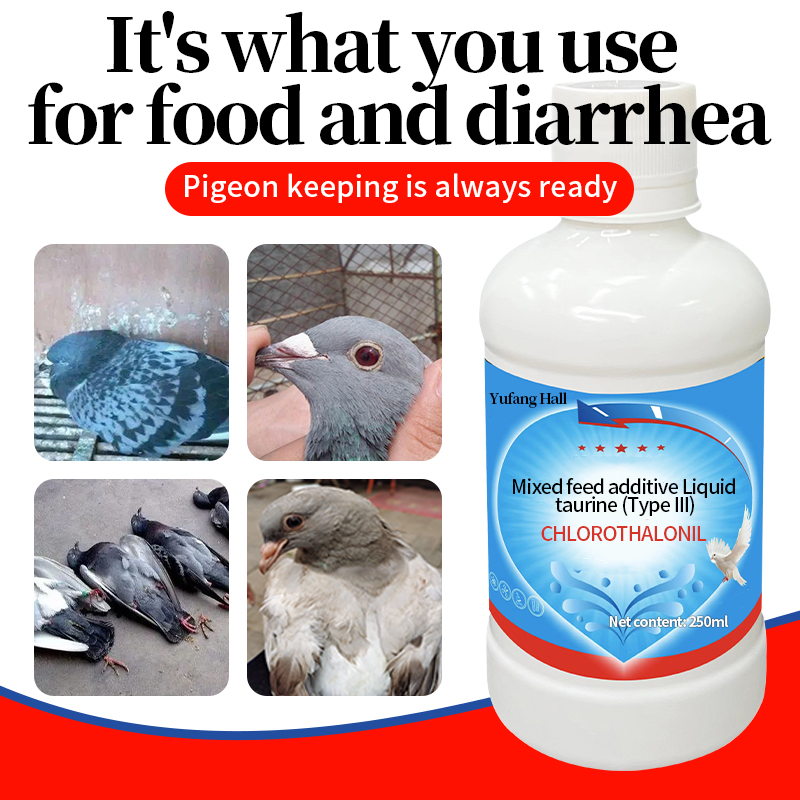
Multiple Functions, Fully Safeguard Pigeon Health
BAI YI QING – Prevent Newcastle Disease and Relieve Symptoms Caused by Salmonella Infection

Solve Rumen Impaction, Bloating and Indigestion in Cattle and Sheep
LIU WEI BAO – Solve Rumen Impaction, Bloating and Indigestion in Cattle and Sheep